

Heat exchangers are crucial components in various industrial and commercial applications, playing a vital role in transferring heat from one medium to another. Among the key elements within a heat exchanger, fan blades are essential for ensuring efficient heat transfer. As a fan blade supplier, I am well-versed in the intricacies of how these components work, and I'm excited to share this knowledge with you.
The Basics of Heat Exchangers
Before delving into the function of fan blades, it's important to understand the basic principles of heat exchangers. A heat exchanger is designed to transfer thermal energy between two or more fluids at different temperatures. This transfer can occur through various mechanisms, including conduction, convection, and radiation. In most practical applications, convection is the primary mode of heat transfer, where a fluid (either liquid or gas) moves over a surface to exchange heat.
There are several types of heat exchangers, such as shell-and-tube, plate, and finned-tube heat exchangers. Regardless of the type, the goal is to maximize the surface area available for heat transfer and to promote efficient fluid flow.
The Role of Fan Blades in Heat Exchangers
Fan blades in a heat exchanger serve a critical function: they enhance the convective heat transfer process by increasing the flow rate of the fluid (usually air) over the heat transfer surface. This increased flow rate helps to carry away the transferred heat more effectively, thereby improving the overall efficiency of the heat exchanger.
Air Movement
The primary function of fan blades is to move air. When the fan rotates, the blades create a pressure difference between the inlet and outlet of the fan. This pressure difference causes air to be drawn into the fan and then forced out in a specific direction. The shape, size, and number of fan blades all influence the amount of air that can be moved and the pressure that can be generated.
For example, a fan with a larger diameter and more blades can typically move more air than a smaller fan with fewer blades. However, the design of the blades also affects the efficiency of the fan. Blades with a curved shape, known as airfoil blades, are more efficient at moving air than flat blades because they create less turbulence and resistance.
Heat Transfer Enhancement
By increasing the air flow rate over the heat transfer surface, fan blades enhance the convective heat transfer coefficient. The convective heat transfer coefficient is a measure of how effectively heat can be transferred between the surface and the fluid. A higher coefficient means that more heat can be transferred per unit time and per unit area.
When the air flows over the heat transfer surface, it picks up heat from the surface and carries it away. The faster the air flows, the more heat it can carry away, and the more efficient the heat transfer process becomes. This is particularly important in applications where high heat transfer rates are required, such as in industrial cooling systems or HVAC units.
Uniform Air Distribution
In addition to increasing the air flow rate, fan blades also help to distribute the air evenly over the heat transfer surface. This is important because uneven air distribution can lead to hot spots on the surface, which can reduce the overall efficiency of the heat exchanger.
The design of the fan and the arrangement of the blades can be optimized to ensure that the air is distributed as evenly as possible. For example, fans with multiple blades can create a more uniform air flow pattern compared to fans with a single blade. Additionally, the use of diffusers or guide vanes can further improve the air distribution.
Types of Fan Blades Used in Heat Exchangers
There are several types of fan blades commonly used in heat exchangers, each with its own advantages and disadvantages.
Axial Fan Blades
Axial fan blades are the most common type of fan blades used in heat exchangers. They are designed to move air parallel to the axis of rotation of the fan. Axial fans are typically used in applications where a high volume of air needs to be moved at a relatively low pressure.
Axial fan blades can be further classified into different types based on their shape and design. For example, propeller blades are simple and inexpensive, but they are not very efficient at high pressures. On the other hand, airfoil blades are more efficient but can be more expensive to manufacture.
Centrifugal Fan Blades
Centrifugal fan blades are designed to move air perpendicular to the axis of rotation of the fan. They are typically used in applications where a high pressure is required, such as in duct systems or in applications where the air needs to be forced through a narrow opening.
Centrifugal fan blades can be classified into forward-curved, backward-curved, and radial blades. Forward-curved blades are the most common type and are suitable for applications where a high volume of air needs to be moved at a relatively low pressure. Backward-curved blades are more efficient but can be more expensive to manufacture. Radial blades are used in applications where a high pressure is required, such as in industrial blowers.
Factors Affecting the Performance of Fan Blades
Several factors can affect the performance of fan blades in a heat exchanger.
Blade Design
The design of the fan blades, including their shape, size, and number, has a significant impact on the performance of the fan. As mentioned earlier, airfoil blades are more efficient than flat blades, and a larger number of blades can typically move more air. However, the design also needs to be optimized for the specific application to ensure maximum efficiency.

Rotational Speed
The rotational speed of the fan also affects its performance. A higher rotational speed generally results in a higher air flow rate and a higher pressure, but it also increases the power consumption and the noise level. Therefore, the rotational speed needs to be carefully selected to balance the performance requirements with the energy consumption and noise constraints.
Air Density
The density of the air also affects the performance of the fan. Air density is influenced by factors such as temperature, pressure, and humidity. In general, a higher air density results in a higher air flow rate and a higher pressure, but it also increases the power consumption. Therefore, the fan needs to be designed to operate efficiently under different air density conditions.
System Resistance
The resistance of the system, including the ductwork, filters, and heat transfer surface, also affects the performance of the fan. A higher system resistance requires a higher pressure to maintain the desired air flow rate. Therefore, the fan needs to be selected based on the specific system requirements to ensure that it can overcome the system resistance and provide the required air flow.
Our Fan Blade Solutions
As a fan blade supplier, we offer a wide range of fan blades for heat exchangers. Our fan blades are designed and manufactured using the latest technologies and materials to ensure high performance, reliability, and efficiency.
We understand that different applications have different requirements, and we work closely with our customers to provide customized solutions. Whether you need axial fan blades, centrifugal fan blades, or any other type of fan blades, we can provide you with the right product.
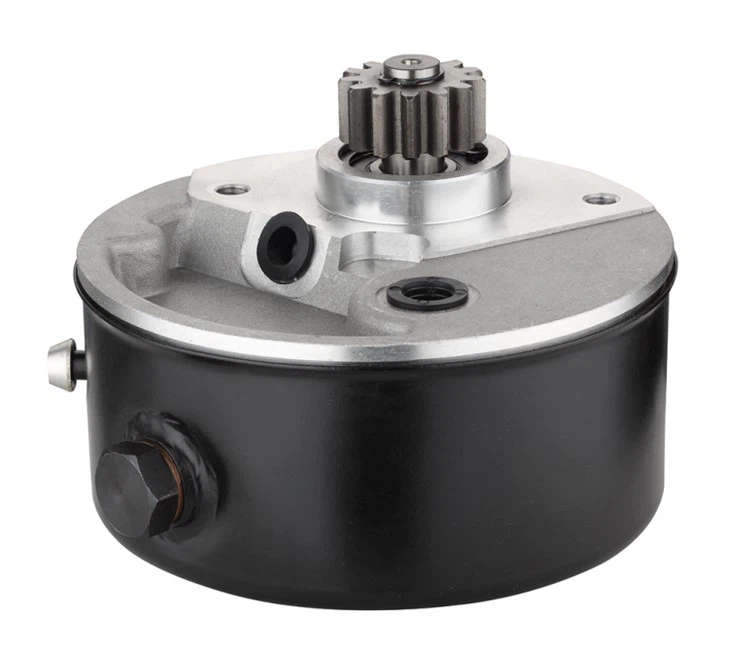
In addition to fan blades, we also offer related products such as Hydraulic Gear Pump Steering Pump for Tractor 527904m93 773126m92, Hydraulic Gear Pump GHP-F2.8/F2.8R for Log Splitter, and Hydraulic Pump for Tractor Auto Parts 81871528 F0nn600bb 83938860 82983657. Our comprehensive product range allows us to provide one-stop solutions for your industrial needs.
Contact Us for Procurement
If you are looking for high-quality fan blades for your heat exchanger or any other related products, we invite you to contact us for procurement. Our experienced team is ready to assist you in selecting the right products and providing you with professional advice. We are committed to providing you with the best products and services at competitive prices.
References
- Incropera, F. P., & DeWitt, D. P. (2002). Fundamentals of Heat and Mass Transfer. Wiley.
- Cengel, Y. A., & Ghajar, A. J. (2015). Heat and Mass Transfer: Fundamentals and Applications. McGraw-Hill Education.
- ASHRAE Handbook: Fundamentals. American Society of Heating, Refrigerating and Air-Conditioning Engineers (ASHRAE).